>Pink Pearl Apples

29 Aug

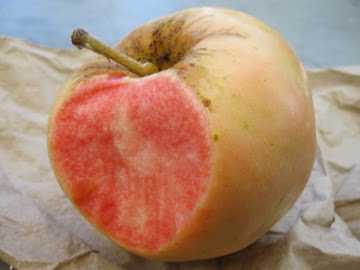
>One year ago, I bit into the most magnificent apple I have ever seen/tasted. It was pink, on the inside! Pink flesh, wow, I could not believe it. A delightful surprise to bite into.

I have since learned that this apple is called a “pink pearl.” Fitting, eh?

The season is upon us, folks: late August through mid September. So keep those eyes peeled for the next round-up of pink pearls.

>Strawberry Rhubarb Pie

26 Aug

>

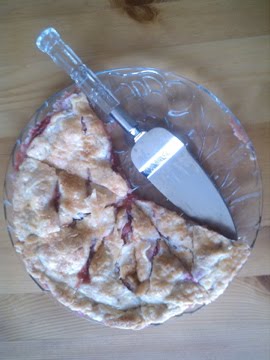
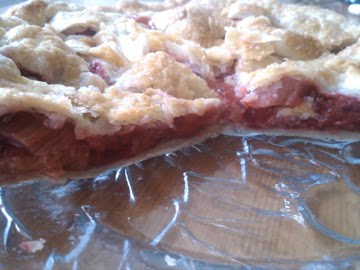
Strawberry rhubarb pie. Lovable lovable pie. Even my Comcast installation guy got to eat a slice of pie, lucky guy, eh? Let me warm you a slice and give you a scoop of my homemade honey vanilla ice cream. Or I can wrap you up a piece to go…How about some pie for breakfast with a nice mug of milky coffee?

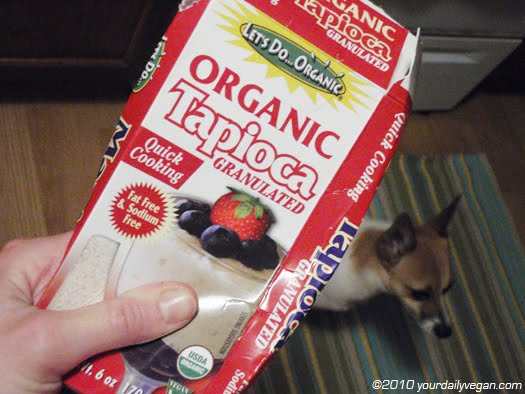
One might ask, “how do you prevent this sought-after sweet treat to keep from getting soggy and overly juicy?” Quick-cooking tapioca does the trick. It is tasteless and helps the juicy berries and rhubarb from turning your pie into a messy ordeal. Quick-cooking tapioca is a thickening agent that helps the pie filling gel together. Some folks use cornstarch as an alternative thickener, however both myself and a few other food bloggers who I confirmed with agree that quick-cooking tapioca is the way to go.

(P.S. This is not my photo, nor is this my dog; image taken off of google images)

I made my pie in a tart shell pan, but you can also use a pie plate, it just depends on your preference. If you decide to use a tart shell pan, it is a good idea to cut out a circle of parchment paper and line the bottom of your pan with the parchment to ensure that your crust does not stick to the bottom of the pan.


Oh, and whatever you do, try not to eat the pie straight from the oven. Wait until the pie is COMPLETELY cool before you cut into it. Trust me, it is worth the wait. Otherwise, you will be sorry that you got sloppy messy slices of pie that are just not as pretty anymore.

So, let us begin our adventure in pie…


Tart and Pie Dough

from Alice Waters’ The Art of Simple Food

Makes two 10-ounce balls of dough, enough for two 11-inch tarts or one double-crust 9-inch pie

Have measured:
1/2 cup ice-cold water

Mix together: 2 cups all-purpose unbleached flour 1/2 teaspoon salt (omit if using salted butter)

Add:
12 tablespoons (1 1/2 sticks) cold butter, cut into small (1/4-inch) cubes

1. Cut or work the butter into the flour with a pastry blender or your fingertips, leaving some of the butter in fairly large, irregular pieces. This will take 1 or 2 minutes. (Or mix for no more than a minute, at medium-low speed, in a stand mixer fitted with the paddle attachment.)

2. Pour in three quarters of the water, stirring all the while with a fork until the dough begins to form clumps. (In the mixer, turn the speed to low and pour the water down the sides of the bowl, mixing for 30 seconds or less.) Keep adding water if needed.

3. Divide the dough in two, bring each part together into a ball, and wrap each ball in plastic. Compress each ball, and then flatten them into disks. Let rest, refrigerated, for 1 hour or longer.

Strawberry Rhubarb Pie

from SmittenKitchen

1 recipe pie/tart dough (enough to make a double-crust pie) (recipe above)
3 1/2 cups (about 1 1/2 pounds, untrimmed) rhubarb, in 1/2-inch thick slices
3 1/2 cups (about 1 pound) strawberries, hulled and sliced if big, halved

1/2 cup granulated sugar
1/4 cup light brown sugar
1 tablespoon lemon juice
1/4 teaspoon salt

1/4 cup quick-cooking tapioca
2 tablespoons unsalted butter, cut into small pieces

1 large egg, beaten to blend with 1 teaspoon water or cream (for glaze)

granulated or raw sugar (for sprinkling)

Preheat oven to 400 degrees F. Take one of your dough disks out of the refrigerator and let it sit out for 15-20 minutes until it becomes malleable but not soft (it should still be fairly cold). On a well-floured counter, roll half of pie dough into a 12 inch round and carefully transfer to a 9-inch pie plate or tart pan. Place it in the refrigerator while you prepare the filling.

Stir together rhubarb, strawberries, sugars, lemon, salt, and tapioca in a large bowl. Mound the filling inside the bottom pie crust and dot with bits of unsalted butter.

Roll the second half of pie dough into an 11-inch circle and cut decorative slits in it. Transfer it to the center over the pie filling. Trim the top and bottom pie dough so that their overhang beyond the pie plate lip is only 1/2-inch. Tuck the rim of the dough underneath itself and crimp it decoratively.

Transfer pie to a baking sheet and brush beaten egg mixture over the dough. Sprinkle with sugar. Bake for 20 minutes, rotate the pie, then reduce temperature to 350 degrees and bake for an additional 25 to 30 minutes, until the pie is golden and the juices bubble visibly.

Transfer pie to a wire rack to cool. When full cool (several hours later or overnight) the juices gel.

**The pie should keep for up to three days at room temperature.

>New Wearable Feedbags

26 Aug

>Check this out!

>Caramel Ice Cream with Sliced Almonds and Heath Bar

23 Aug

>
Making caramel can seem very intimidating at first. You are playing with science. You are playing with fire. You are playing with sugar–hot bubbling sugar. There are different types of caramels that can be made: wet caramel is made by heating a combination of sugar and water in a pan and dry caramel is simply sugar heated without any liquid. Wet caramel is used mostly for sauces and drizzling. This particular caramel ice cream recipe uses the dry caramel technique.

The 2 main things to take note of when making caramel are recrystallization (lumpy clumpy sugar crystals) and burning the sugar. You can avoid recrystallization by making sure that your pan and your sugar have no impurities in them and that you are cooking your sugar in a fairly even layer. Limiting the amount that the sugar is stirred can also help prevent recrystallization (point: do not over-stir). To prevent burning the sugar, it is important to stand guard and hover around the pot. Right when the sugar turns an amber color and starts smoking and foaming a bit, you must remove the pan from heat immediately to stop the sugar from darkening further. Usually, a liquid is added (cream, coffee, orange juice/water…) at this point to help stop it from continuing to cook.

Look, if you mess up, just try again with a new batch of sugar. Sugar is pretty inexpensive and you can think of the process as an educational lesson in cooking and science.

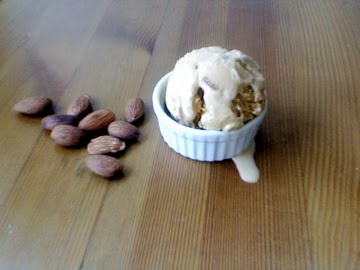
Caramel ice cream is a real treat. This recipe is just a basic dry caramel mixed with a milky creamy custard, but there are all sorts of fun ways to play with caramel ice cream mix: burnt caramel ice cream, salted caramel ice cream, salted butter caramel ice cream (I had this flavor at a shop in Paris, caramel burree sale, mmmmm!)…

I also chose to mix in heath bar candy and chopped toasted almonds. I actually wish that I hadn’t done the heath bar thing because it took away from the actual caramel taste, but it was still absolutely delicious regardless. Next time I think I will pair the ice cream with a flourless chocolate cake or maybe some chewy gingersnap cookies and make ginger caramel ice cream sandwiches. Uh. Yea.


Caramel Ice Cream

from David Lebovitz’s Ready for Dessert

makes about 1 quart (1 liter)

1 cup sugar
2 cups whole milk
1/4 to 1/2 teaspoon sea salt
1 cup heavy cream
5 large egg yolks
1/2 teaspoon vanilla extract

Spread the sugar in an even layer in a large, heavy-bottomed saucepan and cook over medium heat, without stirring, until the sugar begins to melt around the edges. Using a heatproof utensil, slowly drag the liquified sugar to the center and stir gently until all the sugar is melted. Continue to cook, stirring infrequently, until the caramel turns dark amber in color and starts to foam a bit. Remove from heat and immediately add the milk (SLOWLY!). The caramel will bubble up vigorously (WATCH OUT, STAND BACK/WEAR OVEN MITS), then the bubbling will subside.

Set the saucepan over low heat, add 1/4 teaspoon salt, and stir until almost all of the hardened caramel has dissolved into the milk. A few bits may remain, but don’t worry; they’ll melt later on.

Pour the cream into a medium bowl and set a mesh strainer across the top.

In a separate bowl, whisk the egg yolks, then gradually add some of the warm caramel mixture, whisking constantly as you pour. Pour the warmed yolks back into the saucepan. Cook over low heat, stirring constantly and scraping the bottom of the pan with a heatproof spatula, until the custard is thick enough to coat the spatula. Pour the custard through the mesh strainer into the heavy cream. Stir in the vanilla, then taste, and add up to 1/4 teaspoon more salt, if desired.

Set the bowl containing the custard over a larger bowl of ice water. Stir the custard until cool, then cover and refrigerate until thoroughly chilled.

Freeze in an ice cream maker according to the manufacturer’s instructions.

**Optional: Stir in 1 to 2 cups of mix-ins just after churning–chopped chocolate or candy bars (I did chopped toasted almonds with heath bar), bits of broken caramel, crumbled brownies, praline…

or

Make cookies and make caramel ice cream sandwiches!

>Honey Vanilla Ice Cream + Summer Fruit Crisp

18 Aug

>


Amidst my camera breaking, my new apartment still coming together, no Internet at the new apartment, and my weekend getaway trips gallivanting around northern California, my blog posts have been/will be a bit delayed.

My new kitchen is filled with fun gadgets: my KitchenAid candy-apple-red mixer, my mortar and pestle, tons of baking pans, and my ICE CREAM MAKER. And what a better way to break-in the kitchen than to make some refreshing ice cream?! Honey vanilla ice cream!!!

Lately I have been eating tons of melon: cantaloupe, watermelon, orange honeydew melon, canary melon, muskat melon……..mmmmmm. This honey vanilla ice cream is the perfect accoutrement to any melon. For some more melon fun, check out this post by the KitchyKitchen.
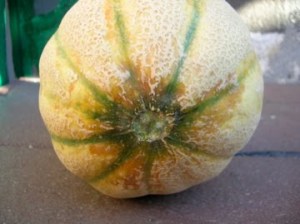

The way that I pick a good melon is to give it a sniff at right at the end where that circular nub is (see above photo). It should smell like fragrant flowers. If there is no smell, you can still buy the melon but let it sit for a few days on the counter. You can also try to shake or knock the melon. If the seeds are loose, the melon is ripe.

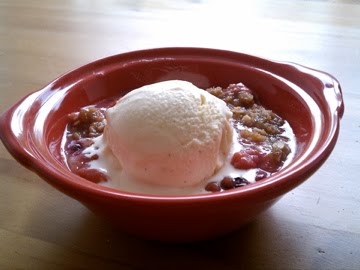
The honey vanilla ice cream can be served with melon, served on its own, served with some peanut butter and sliced sauteed bananas (deconstructed Elvis Presley-style?), served with a summer fruit crisp, or any other way you can imagine.

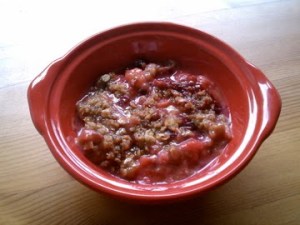
A summer fruit crisp is an easy, comforting dessert that can be thrown together in a pinch. Use whatever fruit you like, sprinkle the crisp topping on, and bake. Gosh, you get your fruit and your oat-y crumbly crunch. And it is just divine with the ice cream.


To make the crisp: I sliced dapple dandy pluots, a nectarine, and sprinkled a few blueberries into an 8 in by 8 in square baking pan (feel free to make minis in little ramekins, too). I added a tablespoon and a half of all-purpose flour (you can also add a sprinkle of sugar and/or lemon depending on the sweetness of the fruit). Then I topped the fruit with some crisp topping (recipe below) and baked it all in a 375 degree oven for about 30-40 minutes. Serve warm with the ice cream on top…YUM!


Honey Vanilla Ice Cream
adapted from Chez Panisse Fruit

makes 1 quart

** BEWARE: This ice cream is really heavy on the honey flavor. If you just want a slight honey flavor, add only 1/2 a cup or less of honey. But if you are a major honey lover, add the whole 3/4 cup (that’s what I did)

6 egg yolks
1 cup half and half (I just used milk because that was all I had…it still came out great)
1 pinch salt
1 vanilla bean
2 cups heavy cream, chilled
1/2-3/4 cup honey, depending on how much of a honey lover you are

Set the heavy cream into a large bowl or bucket and set a fine mesh strainer or sieve over the top. Set the bowl into another larger bowl of ice water.

In a mixing bowl, whisk the egg yolks just enough to break them up. Gently heat the milk and salt in a medium-size saucepan or pot. Split the vanilla bean lengthwise, scrape out the seeds with a paring knife, and put them into the milk mixture along with the bean pod. Stir slowly over low heat until the milk is steaming.

Drizzle the warm mixture into the egg yolks, whisking constantly as you pour (this is called tempering the egg yolks).

Return the milk and egg yolk mixture to the saucepan or pot. Cook the mixture over low heat, stirring slowly and scraping the bottom of the pan with a wooden spoon or heat-resistant rubber spatula until the mixture thickens enough to coat the spoon (this happens at a temperature of about 170 degrees F).

Immediately remove from the heat and strain through the fine-mesh strainer/sieve into the cold cream. Whisk in the 3/4 cup of honey.

Whisk together to cool the mixture over the ice bath. Once chilled, cover the ice cream base and refrigerate until thoroughly chilled (at least a half hour or over-night).

Freeze the mixture according to your ice cream machine’s instructions. Transfer the frozen ice cream to a clean dry container, cover, and store in the freezer for several hours before serving to firm up.

Variations:

To make honey lavender ice cream: Add 1 tablespoon of dried lavender when you are heating the milk.

To make vanilla ice cream, use milk instead of half and half and add 2/3 cup of sugar when you heat the milk. Omit the honey.

Fruit Crisp Topping

adapted from Deborah Madison

3/4 cup light brown sugar
2/3 cup flour
1/2 cup rolled oats or finely chopped almonds
1/4 tsp. salt
1/2 tsp. nutmeg
1 tsp. cinnamon, optional
6 Tbsp. butter, cut into small chunks

Using your fingers or the paddle attachment of a mixer, combine the topping ingredients and work in the butter until the texture is coarse and crumbly.

**The topping can be made ahead and refrigerated for a week or so or frozen for several weeks.