Archive | dinner RSS feed for this section

African G-nut (aka Peanut) Stew

14 Jan


Bored of your regular cooking repertoire? Tired of cooking/eating the same thing all the time? Need ideas for a healthy, hearty vegetarian dinner that comes together in just minutes? Let’s take a little journey to Africa shall we?

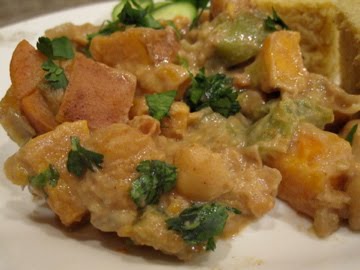
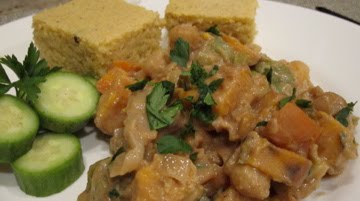
Here is a stew that is so hearty and filling and stick-to-your-stomach good (and good for you, too!). In Africa, peanuts (or “g-nuts,” short for groundnuts) are featured in many meals. Today I have paired the nut with a sweet potato, carrot, onion, green bell pepper, and garbanzo bean stew. You can add whatever vegetables and beans and other goodies that you like–eggplant, peas, tomato, spinach, cauliflower, chilies, pineapple, tofu (or chicken or lamb).

I made some cornbread and sliced up cucumbers to go along with the stew, but it would also be lovely served over rice.

What I love about this stew is that it can be made for one or a few people or multiplied and made for a large crowd. This definitely makes my comfort food list…warm, mushy, hearty stew, and makes great leftovers, too.

Another dish that I like to make is this “G-nut Special Sauce and Sweet Potatoes” from Vegetarian Times Magazine. I have made this dish over and over and just love it!
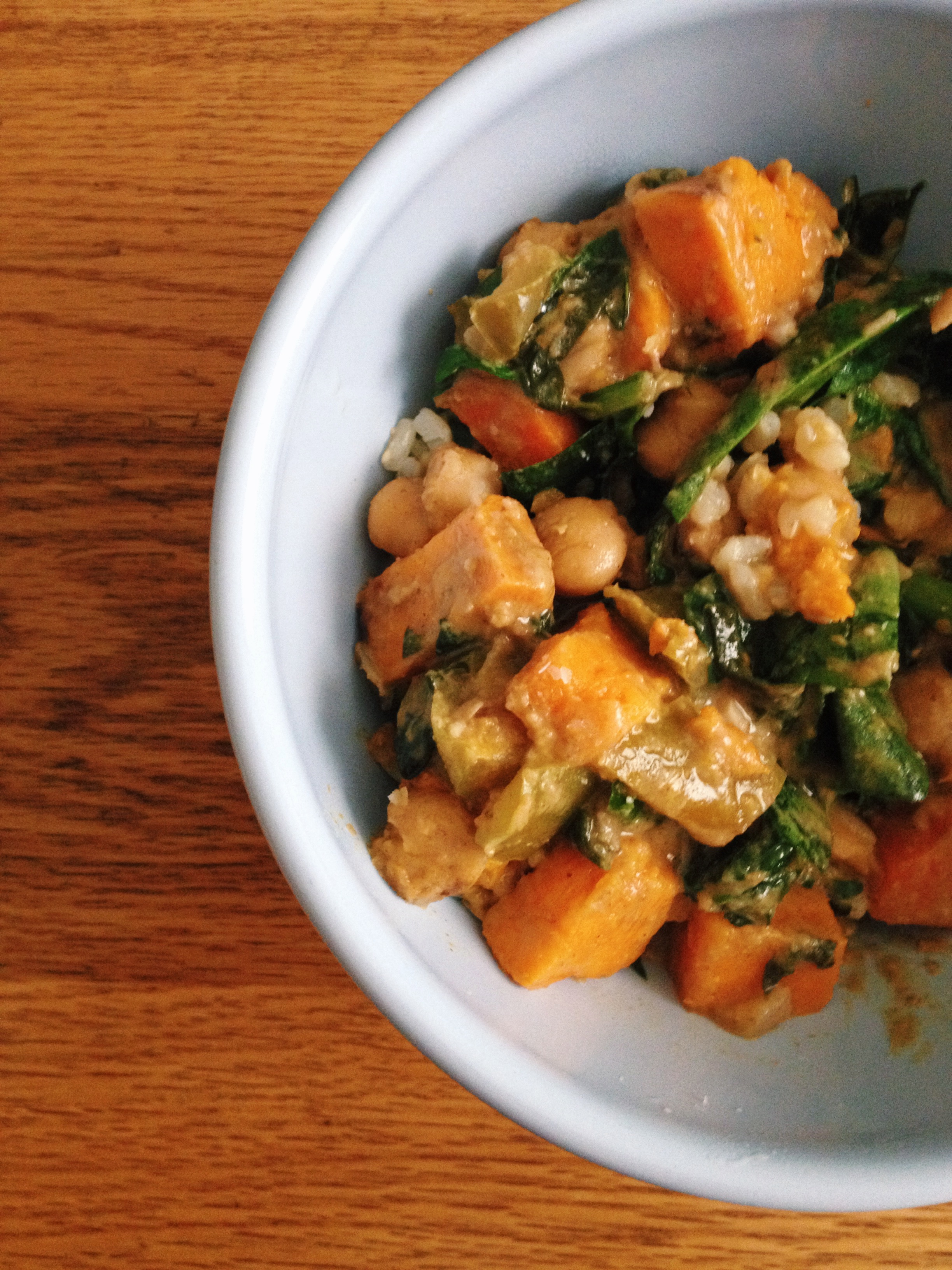
Processed with VSCOcam with c1 preset

Updated photo: 4/26/14

African G-nut (aka Peanut) Stew
based on the recipe from blogger Field to Feastserves 42 Tablespoons vegetable or canola oil
1 medium onion, chopped
1 large leek, white part only, cleaned and sliced
2 garlic cloves, minced
1 teaspoon of fresh ginger, grated
2 teaspoons ground cumin
2 teaspoons ground coriander
2 medium sweet potatoes, diced
1 carrot, diced
1 1/2 teaspoons salt
2 cups veggie broth
1 green bell pepper, diced
1 15-oz can of garbanzo beans
1/2 cup peanut butter
cilantro or parsley, for garnish

1. Heat the oil in a large saucepan over medium heat. Add the onion, leek, garlic and ginger and cook for 5 minutes. Stir in the ground cumin and ground coriander and cook for 1 minute. Add the sweet potatoes and carrot and cook, stirring occasionally, for another 5 minutes.


2. Add the salt, vegetable broth, green pepper and garbanzo beans. Bring the stew to a boil, then cover and reduce to a simmer. Cook for 8-10 minutes, or until the sweet potato and carrot are soft. Mix in the peanut butter and cook for a final 5 minutes. If you want a thinner or thicker stew, you can add more peanut butter or, alternatively, more broth.

3. Serve the stew hot, with the toasted peanuts and cilantro or parsley as a garnish.


Warm Tortilla with Cheese and Egg

6 Jan


Oh brother. How I spoil you.

You are my little experiment. I like to test my recipes and make you eat them. Not so bad, right?

I made you the most rockin’ lunch today. It started with a warmed tortilla, topped with cheese and a fried egg. I threw together some tomato, avocado, and red onion and splashed it with lemon juice, salt/pepper, and a sprinkle of cayenne. With a dash of hot sauce! The warm, slightly browned and crunchy yet soft tortilla is out of this world! Cheesy? You betcha. Eggy? Uhhuh. Colorful? Duh.

Yes, there is a bit of butter and cheese and egg, but you get your protein, your whole grain carbs, and your vegetable/fruit serving. It fills you up and tastes so so so good. You can eat this like a pizza or cut into bite-size pieces. Warning: It can get messy!

Warm Tortilla with Cheese and Egg

tortilla (I used a whole wheat tortilla)
a bit of butter
cheese
egg
salt and pepper
salsa or hot sauce

tomato
red onion
avocado
lemon juice
salt and pepper
cayenne pepper

1. Spread the tortilla with a bit o’ butter on both sides. Heat a non-stick skillet to med-high heat. Place your tortilla on the skillet and cook for about 1-2 minutes or until browned. Flip and cook the other side. Take it off the heat and put some cheese over it. Keep in a warmed oven while you make your egg.

2. Fry your egg, scramble your egg, cook your egg sunny-side up, over-easy, poached, whatever way you like.

3. Place the egg atop your tortilla and cheese and sprinkle with salt and pepper.

4. For your “salsa,” chop up your tomato, red onion, and avocado, sprinkle with salt pepper and a dash of cayenne and squeeze some lemon juice over.

Gorgeous!

Chicken Marbella

4 Jan

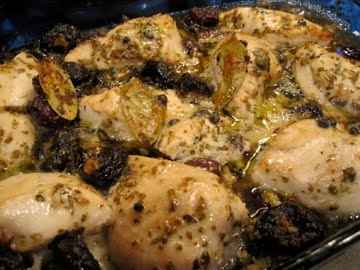
Chicken Marbella. A classic dish from the Silver Palate Cookbook, definitely one of my favorite go-to references for a good ol’ American meal.

Whether you are a chicken novice or a chicken expert, you simply cannot go wrong with Chicken Marbella. Marinated overnight (or for a few hours) with olives, prunes, capers, oregano, Bay leaves, garlic, olive oil, and red wine vinegar, the chicken soaks up all of the sweet, salty, herby flavors. And the best part? Right before you bake the chicken, you sprinkle with brown sugar and pour a dry white wine all over and around the bird. Bellissimo!

My mom is the queen of making dry chicken, so it will always be my goal to NOT make dry chicken. Whatever it takes, as long as the bird is under my watch, it must not be dry.

One trick that I learned to prevent drying out the chicken is to first pound out your breasts. This helps to tenderize the meat and also keeps the pieces the same width all around so they cook evenly. Another key to prevent your chicken from being dry is to find a good marinade and to marinate overnight. Your chicken and your marinade must get to know each other very well if you want them to cooperate.

I like to serve this chicken with a nice grain–rice, couscous, risotto, quinoa, barely…, some sort of roasted veggie assortment or sauteed spinach, and fresh bread (check out my challah bread!). This chicken also goes very well with my hearty grain soup with beans and greens.

I just love this marinade, and you can often spot me dipping my bread in the juices, sopping up as much of the sweet but savory and winey juices as I can! And substitutions are definitely a-okay here: think artichoke hearts instead of capers, figs instead of prunes, basil and parsley instead of oregano…I have also made a vegan/vegetarian version using tofu instead of chicken. With tofu, it is especially important to marinade overnight to bring out the best flavor possible.

Chicken Marbella
from the Silver Palate Cookbook

Ingredients

  • 2 chickens, 2 1/2 lbs each, quartered, bone-in, skin-on (If you are lazy like my fam., just buy the individual pieces: breasts, thighs, whatever you like. Or, you can be way cooler and more economical than me and butcher your chicken.)
  • 1/2 head of garlic, peeled and finely puréed (sometimes I just mince the garlic)
  • 2 Tbsp dried oregano
  • Coarse salt and freshly ground pepper to taste
  • 1/4 cup red wine vinegar
  • 1/4 cup olive oil
  • 1/2 cup pitted prunes
  • 1/4 cup pitted Spanish green olives
  • 1/4 cup capers with a bit of juice
  • 3 bay leaves
  • 1/2 cup brown sugar
  • 1/2 cup white wine
  • 2 Tbsp fresh Italian parsley or cilantro, finely chopped

Method

1 (Optional: Pound your chicken breasts to a nice even consistency) In a large bowl combine garlic, oregano, salt and pepper to taste, vinegar, olive oil, prunes, olives, capers with caper juice, and bay leaves. Add the chicken pieces and coat completely with the marinade. Cover and let marinate, refrigerated, several hours or overnight.

2 Preheat oven to 350°F.

3 Arrange chicken in a single layer in one or two large, shallow baking pans and spoon marinade over it evenly. Sprinkle chicken pieces with brown sugar and pour white wine around them.

4 Bake for 50 minutes to 1 hour, basting frequently with the pan juices (I check it about every 20 minutes). The chicken is done when thigh pieces, pricked with a fork at their thickest point, yield clear yellow juice (not pink).

5 With a slotted spoon, transfer chicken, prunes, olives, and capers to a serving platter. Add some of the pan juices and sprinkle generously with parsley or cilantro. Serve remaining juice in a gravy boat.

Serves 5.

Savory Butternut Squash Crumble

23 Nov

“I’m wary of health faddists. When they’re done talking, you can’t eat anything. We need a nutritionist who loves good food.”  -Julia Child

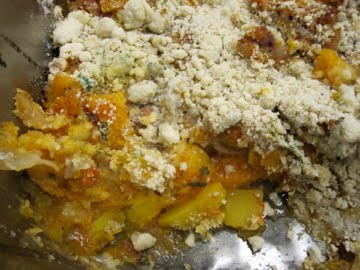
Julia, I completely agree. I believe that a lot of what people produce inside of their heads deters them from tasting new foods. After making this savory squash crumble, a fellow housemate of mine exclaimed, “Wait, there is squash in this? Wow, I don’t even like squash and this is good!”

Lately I have been reading Irena Chalmers’ Food Jobs, a book about the variety of professions available for culinary students, career changers, and FOOD lovers. She is helping me translate my “zest for flavor into a satisfying profession.” Everyday I scour the Internet as well as my library of cookbooks and circle of food-loving friends for new and exciting places to eat, concoctions to create, and finger-licking food finds. Working in the food industry is an ever-changing and on-going process that keeps us all on our toes and constantly having to play and finesse, and finesse, and finesse…

Butternut squash is a beautiful vegetable, with that bright orange color and that bulbous yet elongated shape. Roasted, butternut squash turns soft and caramel-like. Today I took a different approach: I stewed the squash with tomatoes, onions, and spices and then topped it with a crumb topping.

Just a word of advice for all you food photographers out there: I have a slight problem…I tend to make something and either immediately want to eat it or someone else immediately wants to eat it. Understandable. As a result, I present to you some scraps of photos that definitely could have been better—better lighting, better styling, better everything. I’m working on my problem. For now, if you want to see the real deal, check out La Tartine Gourmande’s photos. Yes, she rocks.

Ok, it’s time to get stewing and crumbling!

*NOTE: I made this vegan, but you could add Parmesan cheese and use butter instead of oil in the topping.

**NOTE #2: Feel free to experiment with different herbs (thyme, oregano…), squash varieties (acorn, kabocha…), and cheeses (gruyere, sharp cheddar…).

Savory Butternut Squash Crumble
Recipe adapted from LaTartineGourmande
Serves 6-8

TOPPING

1 cup flour
½ cup walnuts, chopped coarsely
1 tablespoon chopped parsley
1/2 cup grated Parmesan (I omitted the cheese this time to make it vegan)
Pepper, to taste
6 tablespoons butter, diced and at room temperature (I used oil to make it vegan)
optional: 1-2 tablespoons of brown sugar

1.In a bowl, combine the flour, walnuts, parsley, Parmesan, brown sugar, and a generous sprinkle of pepper.

2. Add the butter (or oil) and work with your fingertips until the mixture forms coarse crumbs. Cover and refrigerate while you prepare the filling.

SQUASH

Butter or oil (for the dish)
2 tablespoons olive oil and 1 tablespoon butter (or 3 tablespoons oil)
1 red onion, coarsely chopped
1 teaspoon ground coriander
1 bay leaf
½ cup canned tomatoes
1 peeled butternut squash, cut into 1-inch dice
5 fresh sage leaves, chopped
optional: 1-2 tablespoons of brown sugar
Salt and pepper, to taste
1 tablespoon chopped fresh parsley
optional: 1/2 cup grated Parmesan

1. Generously butter a 10-inch baking dish.

2. In a large skillet over medium heat, heat the olive oil and butter (or just oil) and when the butter melts, and the onion, coriander, and bay leaf and cook, stirring occasionally, for 3 minutes or until softened.

3. Add the tomatoes and cook for 3 more minutes. Add the butternut squash, sage, brown sugar, salt, and pepper. Turn down the heat. Cover and cook for 30 minutes or until the vegetables soften.

4. Set the oven at 350.

5. Discard the bay leaf from the squash mixture. Sprinkle with parsley and Parmesan; stir gently. Transfer the vegetables to the baking dish. Spoon the crumble mixture on top.

6. Bake for 30 to 35 minutes or until the top is golden (My top did not get super golden due to my using oil instead of butter. Oh well, it was still mighty good!).

How to Poach an Egg

20 Nov


“When food is poached, it cooks delicately over the gentlest heat; not a bubble breaks the surface of the liquid in the pan”

–Alice Waters, The Art of Simple Food

The first time I ever ate a poached egg was two years ago at Café Fanny, one of my favorite breakfast spots in Berkeley.

In lieu of attempting to emulate Café Fanny’s picture perfect poached eggs, I purchased an egg poacher. I found, however, that simply pouring an egg into a low-sided sauté pan works best.

Now be warned. The whole egg poaching thing takes a bit of practice to master. I am still in the process of tweaking and refining my technique.

Ok here we go.

Poached Eggs a la Alice Waters and Julia Child
[Oeufs pochés]

Ingredients:
Egg (or eggs)
Water
Vinegar
Salt and Pepper

Step one. Crack an egg into an individual cup or bowl. Be careful not to break the yolk.


Step two. Fill a pan with water about 2 to 3 inches deep; add a large splash of vinegar. Let it come to just below a simmer: very hot, but without any bubbles breaking the surface (as you can see some of my bubbles broke the surface—c’est la vie).


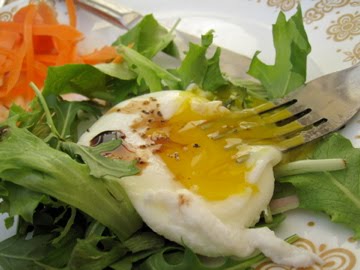
Step three. Hold the cup right at the level of the water and carefully slide the egg in. This gentle entry into the water will help the egg keep its shape. Immediately and gently push the white over the yolk with a wooden spoon for 2-3 seconds (I omitted this part…just decided to have my yolk exposed this time around). After a minute you can gently stir the water to discourage the egg from sticking to the bottom of the pan. Lower the heat if the water starts to simmer.


Step four: The egg will take about 3-5 minutes to cook, depending on your egg. The white will be set but the yolk still soft. Test for doneness by gently lifting the egg with a slotted spoon and pressing it gently with your finger to feel how set the white and the yolk are.

Step five: Carefully remove the cooked egg with a slotted spoon. Sprinkle with salt and pepper.

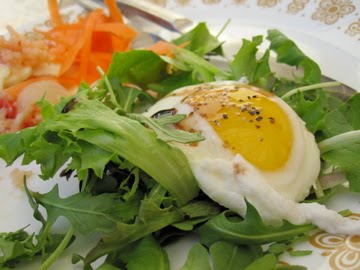
*I chose to drizzle with balsamic vinegar and place my egg over a nice green salad for a quaint lunch. A delicately poached egg atop a hearty slice of lightly buttered toast is also a favorite of mine! Yum!

**You can poach a few eggs at a time. The same recipe applies. When cooking for a crowd, freshly poached eggs can be kept for a few minutes in a bowl of cool water while another batch is being cooked.