Archive | savory RSS feed for this section

How to Poach an Egg

20 Nov


“When food is poached, it cooks delicately over the gentlest heat; not a bubble breaks the surface of the liquid in the pan”

–Alice Waters, The Art of Simple Food

The first time I ever ate a poached egg was two years ago at Café Fanny, one of my favorite breakfast spots in Berkeley.

In lieu of attempting to emulate Café Fanny’s picture perfect poached eggs, I purchased an egg poacher. I found, however, that simply pouring an egg into a low-sided sauté pan works best.

Now be warned. The whole egg poaching thing takes a bit of practice to master. I am still in the process of tweaking and refining my technique.

Ok here we go.

Poached Eggs a la Alice Waters and Julia Child
[Oeufs pochés]

Ingredients:
Egg (or eggs)
Water
Vinegar
Salt and Pepper

Step one. Crack an egg into an individual cup or bowl. Be careful not to break the yolk.


Step two. Fill a pan with water about 2 to 3 inches deep; add a large splash of vinegar. Let it come to just below a simmer: very hot, but without any bubbles breaking the surface (as you can see some of my bubbles broke the surface—c’est la vie).


Step three. Hold the cup right at the level of the water and carefully slide the egg in. This gentle entry into the water will help the egg keep its shape. Immediately and gently push the white over the yolk with a wooden spoon for 2-3 seconds (I omitted this part…just decided to have my yolk exposed this time around). After a minute you can gently stir the water to discourage the egg from sticking to the bottom of the pan. Lower the heat if the water starts to simmer.


Step four: The egg will take about 3-5 minutes to cook, depending on your egg. The white will be set but the yolk still soft. Test for doneness by gently lifting the egg with a slotted spoon and pressing it gently with your finger to feel how set the white and the yolk are.

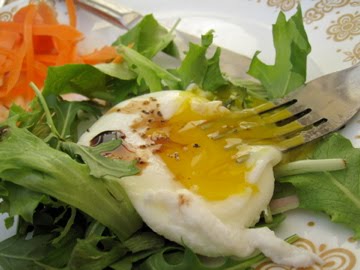
Step five: Carefully remove the cooked egg with a slotted spoon. Sprinkle with salt and pepper.

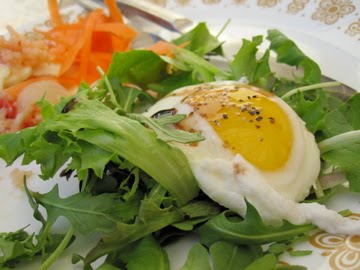
*I chose to drizzle with balsamic vinegar and place my egg over a nice green salad for a quaint lunch. A delicately poached egg atop a hearty slice of lightly buttered toast is also a favorite of mine! Yum!

**You can poach a few eggs at a time. The same recipe applies. When cooking for a crowd, freshly poached eggs can be kept for a few minutes in a bowl of cool water while another batch is being cooked.
Mediterranean Orzo Salad

16 Nov

I could eat bowl after bowl after bowl of this orzo salad. It’s got a salty yet creamy flavor, a nice balance of texture: crunchy, slippery, chewy, crumbled, and a beautiful color scheme.

You know those specialty markets that sell prepared “gourmet food?” Yeah, any little market or deli like Whole Foods (or the Bay Area’s Pasta Shop, Market Hall, Mill Valley Market)…Most of these markets sell some version of an orzo salad, and I will almost always buy some; I simply can’t resist!

What is orzo anyway? Orzo literally translates to “barley” in Italian. It looks like rice but is actually a pasta made of hard wheat semolina.

I love to make salads and throw practically anything and everything I possibly can into them. This orzo salad is indeed very versatile, throw in what you have on-hand in the fridge or pantry! Experiment and get creative!

Mediterranean Orzo Salad
adapted from me eating this salad at any and every specialty market

Ingredients:
  • 8 oz dry orzo
  • handful garbanzo beans
  • handful sun-dried tomatoes
  • handful chopped olives
  • handful chopped artichoke hearts
  • handful fresh spinach
  • handful cherry tomatoes (if in season)
  • handful fresh basil, either whole or cut into a chiffonade
  • handful feta cheese (omit if you want this salad to be vegan)
  • handful chopped or slivered almonds
Directions:

1. Boil water. Once it starts to boil, salt it. Salt it like an ocean. Pour in the orzo and cook until it is done. Drain. (Optional: reserve some of the pasta water in case you want to add it back later if the orzo sticks together).
2. Combine orzo, and rest of the ingredients. Stir it all up and eat! Simple as that.

Homemade English Muffins

23 Oct


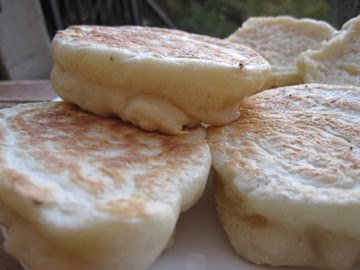
I did it! I made English muffins from scratch!

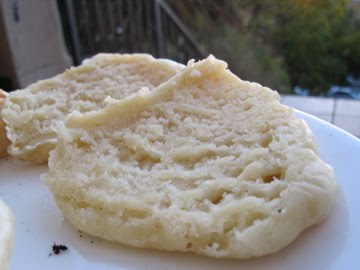
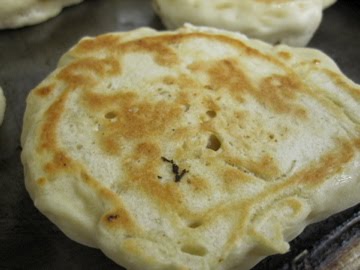
They were even poofy and had the little holes in the center, just like the store-bought kind—but better of course! I think that I exclaimed, “Oh! These are soooo cute!” at least 10 times while I was making them.


Growing up, my mom used to toast me an English muffin spread with butter before school. Oh memories…

What’s not to love about puffy, light, and fluffy English muffins?! Split in half, perfectly toasted, and spread with the topping of your choice (butter, jam, cheese, honey, peanut butter, lemon curd…), these griddle-cooked buns are just a dream!


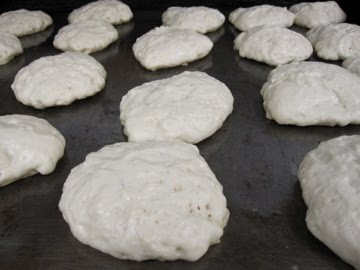
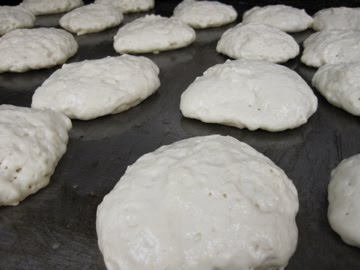
One of the many perks of living in a house with sixty people is that we have access to a huge industrial kitchen complete with two ovens, six stovetop burners, and a large griddle. When I was ready to cook these little guys I just plopped them onto the hot griddle and bam! Done in just minutes!


Simple, on-hand ingredients and no kneading necessary! What more could I ask for?!

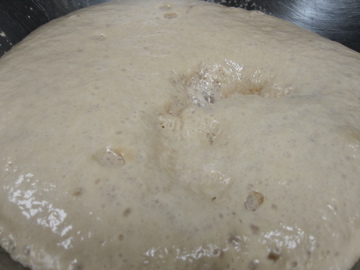
Check out the foamy yeast, water, sugar mixture! It’s aliiiivvvvvveeee!


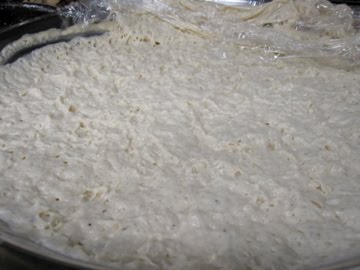
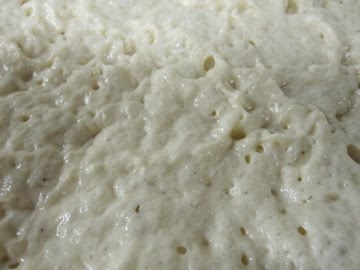
And here is the dough after the 40 minute rise!

Very sticky!

I made two versions of these English muffins—in one I used nonfat milk and the other batch I made vegan and used soymilk (both tasted great, I could barely tell the difference). If you want to get fancy you could mix in cinnamon and raisins, or maybe you are feeling festive and want to toss is some pumpkin puree!

As a nice finishing touch, you could dust the muffins with some cornmeal for added texture!

English Muffins
Adapted from BakingBites

Makes 10-12 muffins

1/3 cup water, warm (110F)
1 tbsp sugar
2 1/2 tsp active dry yeast
1 cup nonfat milk (or soymilk), slightly warm (100-110F)
3/4 tsp salt
2 cups all purpose flour

  • In a large bowl, whisk together water, sugar and yeast and let mixture stand for 10 minutes, until slightly foamy (my mixture got super foamy; it was totally awesome!).
  • Using a wooden spoon, stir in remaining ingredients and mix until smooth (At this point, if you want, you can add in whatever mix-ins your heart desires–raisins, pumpkin puree, chocolate chips…).
  • Cover with plastic wrap and set aside for 40 minutes.
  • Heat a griddle/nonstick frying pan over medium/medium-high heat (water dropped on the griddle evaporates very quickly). Lightly grease with cooking spray.
  • Drop dough by scant 1/4 cupfuls onto greased surface and cook until medium brown on the bottom. The top with look set and the sides will appear somewhat dry. The exact time depends on the temperature of your griddle and the size of your muffins, but expect this to take several minutes. Flip over and cook 2nd side until brown.
  • Cool on wire rack for at least 15 minutes or until completely cool.
  • When ready to serve, split muffins with a fork and toast. Serve with butter, jam, or any topping of your choice.

>Lamb Roasted with Garlic, Fresh Herbs, and Red Wine

11 Oct

>

“I’d rather make something and blow your mind than make something and blow my mind.”
–Michael Wild, Baywolf Restaurant

My mom is a funny woman. Whenever I make her taste something out of her normal eating pattern she will say, “I don’t usually like ____, but this is great!” or “I don’t usually eat ____, but wow is this good!”

Like mother like daughter, today I will say, “I don’t usually eat lamb, but wowza this is mmm mmm good!” Super tender. Marinated overnight with fresh mint and rosemary, garlic, cumin, red wine, and vinegar. Slow roasted in the oven. Butchered to perfection.

Back in the day I used to say that I would never cook meat because I did not like to touch, smell, or look at the raw meat. Let’s just say I conquered that fear. Actually, I quite enjoy rubbing my hands all over a piece of raw meat. It is really soft and almost therapeutic?! Sometimes I even feel like a doctor preparing for surgery. Okay, that may be taking it too far…

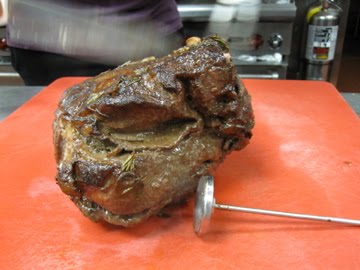
Anyway, this was my first attempt at making lamb, and I successfully did it for a house of 60 people! I wish I could have captured a more decent picture of the lamb, sliced and plated and garnished with fresh herbs; however it was devoured before I had the chance.

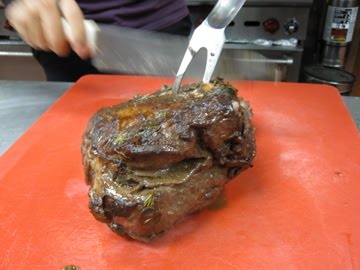
So here you go, a picture of the huge hunk of meat just before we sliced it.


I decided to use cumin in my marinade because I was making some other dishes that incorporated the spice. Feel free to experiment and add whatever you like to your marinade. You could go for a more Asian style and add chili paste and orange juice, or you could go Italian and add artichoke hearts, olives, and oregano.

This was my menu:
• Cubed melon, cucumber, and red onion salad dressed with balsamic
• Lamb Roasted with Garlic, Herbs, and Red Wine
• Cumin and Turmeric mashed sweet potatoes with spinach, onions, and chickpeas, topped with a peanut-sauce
• Roasted Kale “chips”
• Roasted Parsnips and Beets

Some key tips that I found helped me throughout the process:
(thanks to Alice Waters and her book The Art of Simple Food)

-Cut slats into the meat and shove crushed garlic and herbs in between the slats.

-Make sure that you marinate the lamb for at least a few hours, best if overnight.

-Let the meat come to room temperature before placing in the oven; otherwise it will cook unevenly (aka the outside will be fully cooked before the inside has even had a chance to warm up). Take the meat out at least 1-2 hours ahead of time.

-Keep basting and turning so as to ensure juicy meat.

-The lamb will be done when a meat thermometer reads 128°F.

-After you take the meat out of the oven and before slicing it, you should let the meat rest for about 20 minutes to let the internal temperature stabilize. This is so all of the juices do not leak out, leaving you with unevenly cooked and overly dry pieces.

Roast Lamb with Garlic, Fresh Herbs, and Red Wine
Adapted from The Silver Palate

serves 6-10

*Fresh rosemary, about a tablespoon or so
*Fresh mint leaves, about ½ a cup
*5 garlic cloves, crushed
*½ cup of vinegar (I used half balsamic and half red wine vinegar)
*¼ cup of soy sauce
*½ cup of dry red wine (I used “Two-buck Chuck,” half Cabernet and half Merlot)
*1 Tablespoon of cumin
*black pepper
*1 big hunk of lamb (I think I used the thigh?), about 5 pounds or so

*2 Tablespoons Dijon mustard

1. Cut slats in the lamb. In other words, use a sharp knife to make a few slits (about 3-5) in your hunk of lamb.
2. Combine herbs, garlic, vinegars, soy sauce, red wine, cumin, and black pepper in a bowl. Add the lamb and turn to coat with the marinade. Shove some of the garlic and herb-y pieces in the slits.
3. Marinate the lamb, covered, in the refrigerator, overnight.
4. The next day, take the lamb out of the refrigerator and place it in a shallow roasting pan with all of the marinade. Let it come to room temperature.
5. Preheat oven to 350°F.
6. Spread the mustard over the meat.
7. Bake for 1 ½ hours, or 18 minutes per pound, basting occasionally. The roast will be medium rare (Bake for another 10-15 minutes for well-done meat).
8. Let the roast stand 20 minutes before carving. Serve with the pan juices.

>Roasted Eggplant Spread on Crostini

25 Sep

>
Fun Fact: An eggplant is actually a berry.

I know, sounds crazy, right? Typically thought of as a vegetable, the eggplant really is just a large bulbous purple berry.

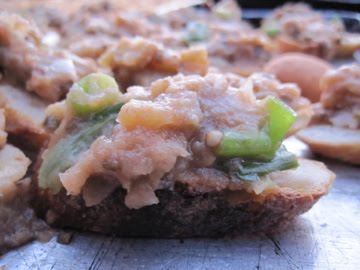
Now don’t get me wrong, I probably would not mix this kind of berry in with my cereal…but I definitely would roast it in the oven and puree it with some tomatoes, roasted garlic, onions, and lemon juice and then spread it on crostini. Ooo la la finger food!!

Roasting the eggplant whole is easy. Are you ready? Take the eggplant, plop it on a sheet tray as is (no oil needed), put it in the oven at 350°F, and in about 60-75 minutes you’ve got one soft and roasted berry!

Next. Roasted garlic. Yes. Chop the end off a head of garlic. Drizzle with olive oil. Wrap in foil. Bake for an hour (any temp. from 350-450°F will do).

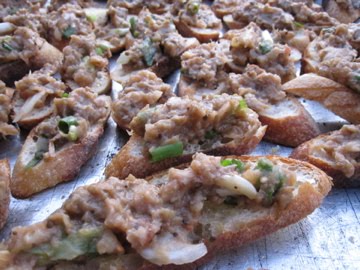
These two ingredients—roasted eggplant and garlic—make this sumptuous eggplant spread sing on the toasted baguette!

Finger food is just too fun! Who needs forks and knives: the phalanges are our natural utensils!!

Once again, I made this for my 60-person co-op and multiplied the recipe by 8. Touché!

Roasted Eggplant Spread on Crostini
Adapted from Goodthingscatered

Makes about 30 slices

Ingredients:
1 medium eggplant
2 tomatoes, chopped and peeled
1/2 medium red onion (feel free to use white onion or shallots)
Roasted garlic (use about half a head, maybe the whole thing if your feelin’ good!)
1 Tbsp olive oil, plus more for crostini
1 Tbsp fresh lemon juice
1 tsp kosher salt
1 tsp freshly ground pepper

1 baguette, preferably sourdough, sliced
2 scallions, white and light green portion thinly sliced

optional:
1/4 c. cilantro
1/4 c. pitted kalmata olives

Directions:
1. Preheat oven to 350°F and place eggplant on a lined baking sheet.

2. Place baking sheet into oven and roast until eggplant looks wilted and skin is easily pieced with a fork, about 60-75 minutes.

3. Meanwhile, cut off the tip of the head of garlic, drizzle with olive oil and wrap in foil. Throw this in the oven with the eggplant (It will take approximately the same time to cook as the eggplant).

4. Remove eggplant and garlic from oven and cool completely. If you prefer, peel the eggplant. If not, go for the rustic feel and leave the peel on.

5. In the bowl of food processor, combine tomato, red onion, garlic and olive oil. Pulse to process until well combined.

6. Add eggplant (cilantro, olives), lemon juice, salt, and pepper and pulse until ingredients are roughly chopped to the consistency of a salsa (about 4-5 pulses) and set aside.

7. Preheat oven to 450°F and place baguette slices onto baking sheet. Brush each slice lightly with olive oil.

8. Place baking sheet into oven and bake until edges are lightly golden, about 10 minutes.

9. Remove from oven, place a spoonful of eggplant spread onto each slice and place on serving platter.

10. Top with sliced scallions and serve. FINGER FOOD!! Woo hoo!