
Archive | bread RSS feed for this section

Homemade Croissants, Part II: Rolling, Baking, Eating

15 Dec

Ok folks, so now that you have gone through part I of the adventure in homemade croissants, you’ve got your laminated dough ready to be rolled and shaped and eaten!

This was the scary part for me. How can I possibly roll these little guys out to look the way they do in a real French bakery (well, I’ve still never been to France but I have a very distinct image in my head)?
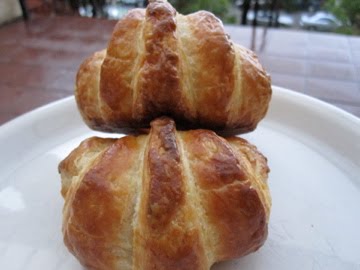
How big should I make my triangles? Should they be equilateral, isosceles…? Do I pinch my ends together or leave them open?

Stephanie. Calm down. Breathe. You can do this. Lets take it step-by-step, shall we?

To begin, you should have ready a baking sheet lined with parchment paper and a rolling pin and pizza cutter nearby.

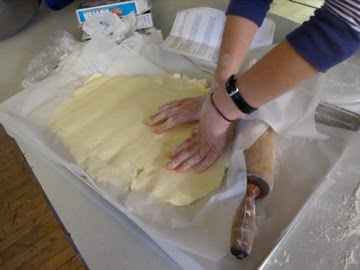
Step 1: Take you laminated dough out of the refrigerator. It should look like this:
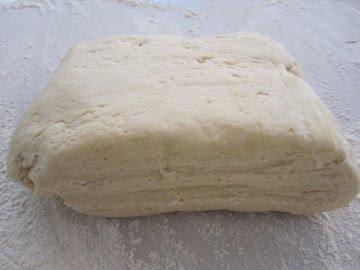
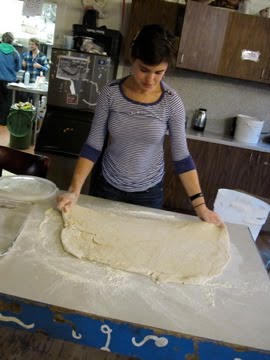
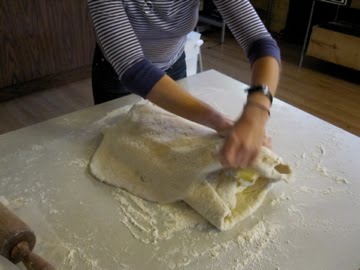
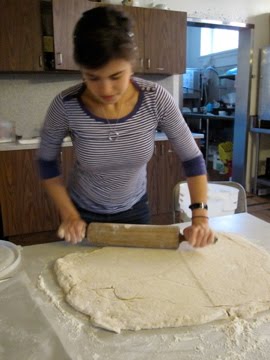
Step 2: On a lightly floured surface, roll your dough out into a large rectangle about ½ an inch thick and maybe 2 feet wide. Using a pizza cutter, I cut my rectangle in half the long way, so that I had two rectangles, each about 2 feet wide and 6 inches tall.

Step 3: Using your pizza cutter, cut your dough into long isosceles triangles. At the restaurant, we way out each triangle to roughly 3 ¾ oz., but I just eyeball it when I make them at home. Your triangles should look similar to this:
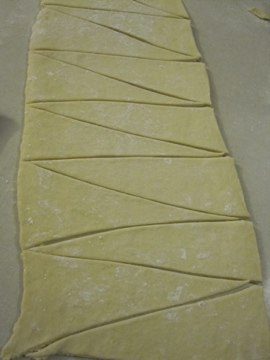
Step 4: Cut a tiny slit at the base of each triangle. Also, I like to stick any extra leftover end pieces of dough inside some of the triangles. Nothing goes to waste!
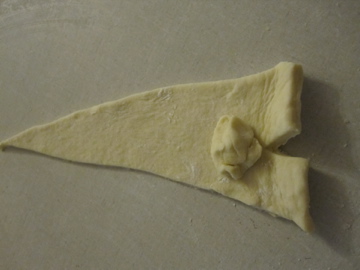
Step 5: With the base closest to you, begin to roll your croissant outward, your right hand rolling to the right, your left hand rolling to the left. Then, turn your triangle so the tip faces you and simultaneously stretch the dough with your right hand and roll it toward you with your left hand. Tuck the end of the tip underneath and pinch your sides together.

Optional: You can fill your croissants with prosciutto and cheese, with chocolate, with anything you like! Plain are a good place to start, though.

Step 6: Place your croissants on a baking sheet lined with parchment. Either wrap in saran wrap and stick them in the fridge overnight, or let your croissants sit at room temperature until they are nice and springy when you touch them.
**If you stick your croissants in the fridge, just pull them out about 40 minutes before you want to bake them so that they can come to room temperature and proof.
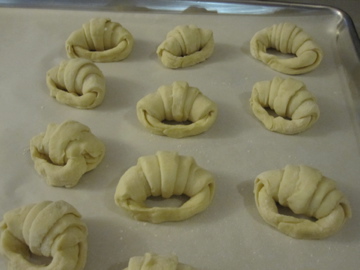
Step 7: When you are ready to bake, preheat your oven to about 400-425°F. Crack an egg and beat it with a touch of cream. Brush your croissants with the egg wash. Bake for about 20-25 minutes until golden everywhere.

OMG eat them eat them eat them…yum yum yum, they are so beauuuuttttiiiiifffffullll and delicious and flaky and warm! Gah!!!!
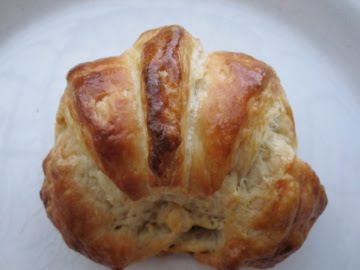
**NOTE: Rolling these out takes a bit of practice. The first time I made these all on my own, I did not pinch my ends together nor did I make sure the tip of my triangle was tucked underneath. Alas, here is what my first batch came out looking like:
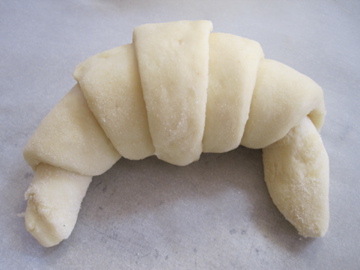
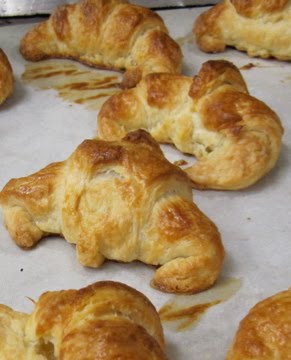
Not too shabby, but I like the pinched ends look better!
Homemade Croissants Part I: Laminating the Dough

14 Dec

Homemade croissants. The ultimate guide. Arrrrrreeeee yooooooouuuuu reeaaaaaaddddddy?!

I think we may need to do a warm-up before we start.

Drop and give me 20 push ups. Ok, now lets see those arm muscles go to work!

Homemade croissants are very simple (I know you think I’m crazy for saying that making croissants are simple, but keep reading). Only a few ingredients needed to make a big, flaky, buttery pastry. What makes the process so daunting is the amount of time it takes; not necessarily on-hand time, just waiting around time. Rolling out your dough, folding it, refrigerating for an hour. Rolling out your dough, folding it, refrigerating. Etc. etc. etc.

Ok people, really, it is sooooooo worth it! You can make a bunch of dough and just freeze the amount that you are not using right away.

I want to make this dough again and again and again (and I will).

Alright, pop quiz. What does it mean to laminate dough? Laminate means alternating layers. In the culinary world, this means alternating layers of dough-butter-dough in the case of puff pasty, flaky pastry, Danish or croissant dough.

I made a LOT of dough. Like a LOT. I used roughly 12 cups of flour and 3 pounds of butter. Yes people, 3 pounds of butter! (Just remember, those 3 pounds got spread over many many many croissants).

Here I give you an abbreviated version of my dough recipe. Shout out to my boss, Kiri, who showed my the ways of croissant making!

You ask: Stephanie, how dooooo you do it?
I answer: why LOVE of course!

What follows is a quick overview of the process, step-by-step, picture-by-picture (the actual recipe is below):

Yeasty, sugary, milky, foamy mixture

Yes I used 3lbs. of butter


I got a little help from one of my housemates to pound out the butter (here is where the push-ups begin to come in handy)!


Yeasty flour mixture ready to be rolled out


Here is the yeasty flour mixture rolled out into a rectangle


Lay your block of butter on top of the flour mixture like so


Fold it like a letter (in thirds)

Nice!

Once again, push-ups are helpful to build up the arm strength

This is what your dough should look like when done! Yahoooo!
Croissant Dough
Recipe from Kiri, adapted from Nancy Silverton

Yield: about 2 1/2 lbs. of dough (aka about 20 croissants?)
Ingredients

* 1 1/2 cups whole milk, heated to warm (105°F–110°F) (You should be able to comfortably stick your finger into the warm milk)

* 1/4 cup sugar (I used half brown, half white)

* 1 tablespoon plus 1/4 teaspoon active dry yeast (from two 1/4-oz packages)

* 4 cups unbleached all-purpose flour (you may need to add more or less depending on your dough)

* 1 Tablespoon kosher salt

* 3 sticks (1 1/2 cups) cold unsalted butter

Make dough:
Stir together warm milk, sugars, and yeast in bowl and let stand until foamy, about 5 minutes. (If it doesn’t foam, discard and start over.) Add your flour and salt and mix by hand until dough is smooth and very soft, about 7 minutes (or if you own a standing Kitchen Aid mixer, you can mix the dough with a dough hook).

Transfer the dough to a work surface and knead by hand 2 minutes more, adding more flour as necessary, a little at a time, to make a soft, slightly sticky dough. Form dough into a roughly 1 1/2-inch-thick rectangle and chill, wrapped in plastic wrap, until cold, about 1 hour.

Prepare and shape butter:
After dough has chilled, arrange sticks of butter horizontally, their sides touching, on a work surface. Pound butter with a rolling pin to soften slightly (butter should be malleable but still cold). Scrape butter into a block and put on a kitchen towel or piece of parchment paper, then cover with other towel or parchment. Pound and roll out on both sides until butter forms a uniform 8- by 5-inch rectangle. Set aside for now.

Roll out dough:
Unwrap dough and roll out on a lightly floured surface, dusting with flour as necessary and lifting and stretching dough (especially in corners), into a 16- by 10-inch rectangle. Arrange dough with a short side nearest you. Put butter in center of dough so that long sides of butter are parallel to short sides of dough. Fold as you would a letter: bottom third of dough over butter, then top third down over dough.

Turn dough so a short side is nearest you, then flatten dough slightly by pressing down horizontally with rolling pin across dough at regular intervals, making uniform impressions. Roll out dough into a 15- by 10-inch rectangle, rolling just to but not over ends.

Fold in thirds again like a letter, as above, stretching corners to square off dough, forming a 10- by 5-inch rectangle. (You have completed the first “fold.”) Chill, wrapped in plastic wrap, 1 hour.

Make remaining “folds”:
Make 3 more folds in same manner, chilling dough 1 hour after each fold, for a total of 4 folds. (If any butter oozes out while rolling, sprinkle with flour to prevent sticking.) Wrap dough tightly in plastic wrap and chill at least 8 hours but no more than 18 (after 18 hours, dough may not rise sufficiently when baked).

****NOTE: Since I made about 3 times this recipe, I cut my dough into thirds at the end, wrapped each one in saran wrap, stuck one in the freezer, and the rest in the fridge.

Homemade English Muffins

23 Oct


I did it! I made English muffins from scratch!

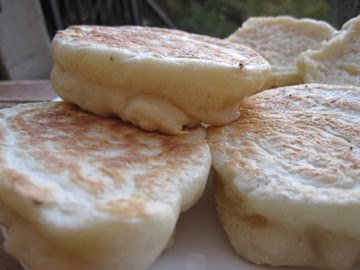
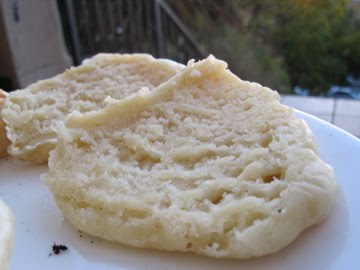
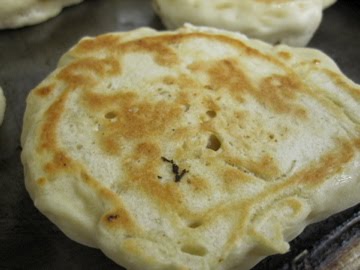
They were even poofy and had the little holes in the center, just like the store-bought kind—but better of course! I think that I exclaimed, “Oh! These are soooo cute!” at least 10 times while I was making them.


Growing up, my mom used to toast me an English muffin spread with butter before school. Oh memories…

What’s not to love about puffy, light, and fluffy English muffins?! Split in half, perfectly toasted, and spread with the topping of your choice (butter, jam, cheese, honey, peanut butter, lemon curd…), these griddle-cooked buns are just a dream!


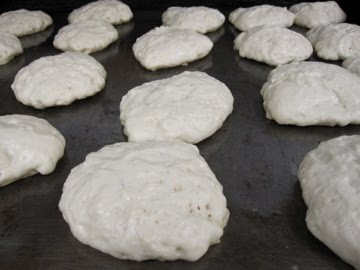
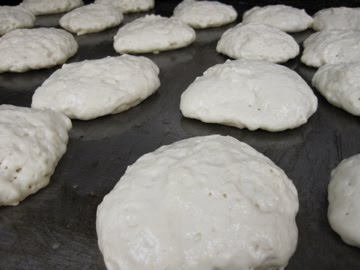
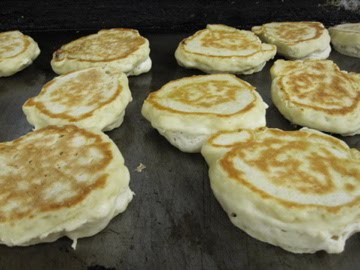
One of the many perks of living in a house with sixty people is that we have access to a huge industrial kitchen complete with two ovens, six stovetop burners, and a large griddle. When I was ready to cook these little guys I just plopped them onto the hot griddle and bam! Done in just minutes!


Simple, on-hand ingredients and no kneading necessary! What more could I ask for?!

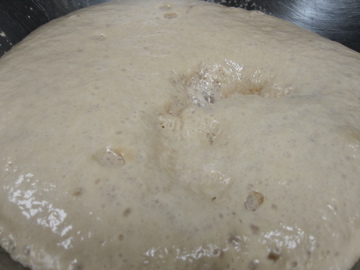
Check out the foamy yeast, water, sugar mixture! It’s aliiiivvvvvveeee!


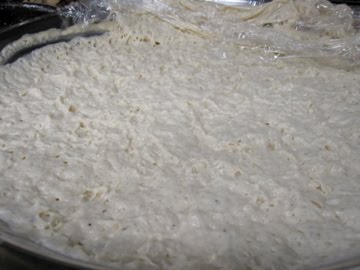
And here is the dough after the 40 minute rise!

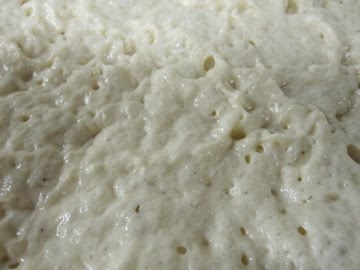
Very sticky!

I made two versions of these English muffins—in one I used nonfat milk and the other batch I made vegan and used soymilk (both tasted great, I could barely tell the difference). If you want to get fancy you could mix in cinnamon and raisins, or maybe you are feeling festive and want to toss is some pumpkin puree!

As a nice finishing touch, you could dust the muffins with some cornmeal for added texture!

English Muffins
Adapted from BakingBites

Makes 10-12 muffins

1/3 cup water, warm (110F)
1 tbsp sugar
2 1/2 tsp active dry yeast
1 cup nonfat milk (or soymilk), slightly warm (100-110F)
3/4 tsp salt
2 cups all purpose flour

  • In a large bowl, whisk together water, sugar and yeast and let mixture stand for 10 minutes, until slightly foamy (my mixture got super foamy; it was totally awesome!).
  • Using a wooden spoon, stir in remaining ingredients and mix until smooth (At this point, if you want, you can add in whatever mix-ins your heart desires–raisins, pumpkin puree, chocolate chips…).
  • Cover with plastic wrap and set aside for 40 minutes.
  • Heat a griddle/nonstick frying pan over medium/medium-high heat (water dropped on the griddle evaporates very quickly). Lightly grease with cooking spray.
  • Drop dough by scant 1/4 cupfuls onto greased surface and cook until medium brown on the bottom. The top with look set and the sides will appear somewhat dry. The exact time depends on the temperature of your griddle and the size of your muffins, but expect this to take several minutes. Flip over and cook 2nd side until brown.
  • Cool on wire rack for at least 15 minutes or until completely cool.
  • When ready to serve, split muffins with a fork and toast. Serve with butter, jam, or any topping of your choice.

Challah Bread

18 Sep

IMG_3895
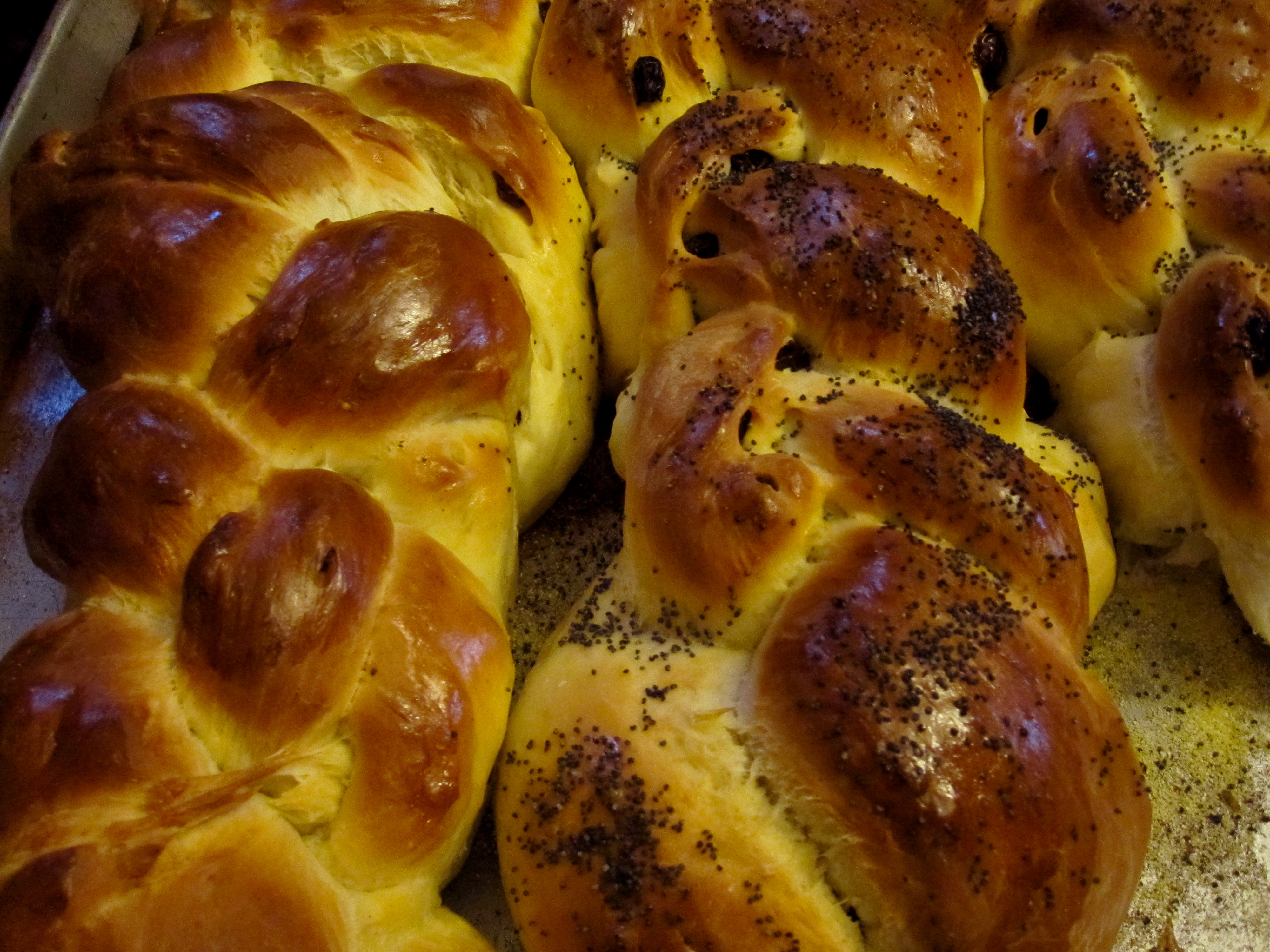
Rosh Hashanah, the Jewish New Year, is just around the corner. To celebrate, I made 8 loaves of this comforting, traditional egg-bread known as “challah.”

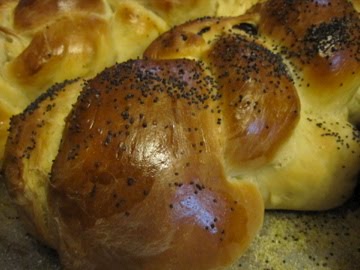
The smell of warm homemade bread just fills the whole house and makes everyone smile! Crisp and browned on the outside, soft and doughy on the inside, loaded with raisins and topped with seeds, this bread will make you hoot n’ challah.

Growing up, my mom’s best friend would invite my family over for dinner and her homemade challah bread was always a huge hit! I dedicate this post to her for inspiring me to make yummy, yummy Jewish food!
IMG_3896
Usually when I make challah bread, I throw all of my ingredients in a bread machine and let it do all the kneading for me. Easy peasy.

This time, however, I had no bread machine and kneaded the dough with my super human arm strength. Actually, it was very easy and came out better than my bread machine challah because I could control how much it really “needed to be kneaded (hehe)!”

Here is some dough in the process of rising! So light and fluffly!

In order for challah to be challah and not just egg-bread, you must tear off a small walnut-size piece of dough and say a blessing. Ok, repeat after me:

“Baruch ata Adonoy, Eloheinu melech ha-olam, asher kidishanu bimitzvo’sav, vitzivanu lihafrish challah min ha-issa.Blessed are You God, King of the Universe, Who made us holy with His commandments, and commanded us to separate challah from the dough.”

Got it? Ok. Thought so. Good.

IMG_4953

My 60+ housemates gobbled these loaves up!

Also on the menu this evening was:

The Silver Palate’s Chicken Marbella (chicken with prunes, olives, artichoke hearts, oregano, and white wine)
-Beet salad with shallots, feta, and red wine vinegar
Hearty bean soup with barley, kale, and tomatoes
-Sautéed green beans

Boy am I stuffed!

IMG_3897

Hoot n’ Holla Challah (Egg Bread)

Adapted from SmittenKitchen
Time: about 1 hour, plus 2 1/2 hours’ rising
Yield: 2 loaves (multiply the recipe by 4 if cooking for 60 hungry college students)

1 ½ packages active dry yeast (1 1/2 tablespoons)
1 tablespoon plus ½ cup sugar
½ cup olive or vegetable oil, plus more for greasing the bowl
5 large eggs (1 is used at the end for egg wash)
1 tablespoon salt
8 to 8 ½ cups all-purpose flour
½ cup raisins per challah, if using
Poppy and/or sesame seeds for sprinkling.

1. In a large bowl, dissolve yeast and 1 tablespoon sugar in 1 ¾ cups lukewarm water.

2. Whisk oil into yeast, then beat in 4 eggs, one at a time, with remaining sugar and salt. Gradually add flour. When dough holds together, it is ready for kneading.

3. Turn dough onto a floured surface and knead until smooth (~ 5-10 minutes). Clean out the bowl and grease it, then return dough to bowl. Cover with plastic wrap, and let rise in a warm place for 1 hour, until almost doubled in size (Dough may also rise in an oven that has been warmed to 150°F then turned off). Punch down dough, cover and let rise again in a warm place for another half-hour.

4. To make a 4-braid challah, take half the dough and form it into 4 balls (take off a little tiny piece for the blessing and bake it with your loaves but DO NOT eat it). With your hands, roll each ball into a strand about 12 inches long and 1 ½ inches wide. Place the 4 in a row, parallel to one another. Pinch the tops of the strands together. (***At this point, if you decide to use raisins or chocolate chips, you can put them into the middle of each strand, pinching the strands closed to make sure the raisins are not too exposed to the outside).

4 ½. Move the outside right strand under 2 strands. Then take the second strand from the left and move it over one to the right. Take the outside left strand and move it under 2. Move second strand from the right over one to the left. Start over with the outside right strand. Continue this until all strands are braided. Tuck the ends underneath. Make a second loaf the same way.

5. Grease a cookie sheet and sprinkle with cinnamon and cornmeal. Place braided loaves on the cookie sheet with at least 2 inches in between. Spray saran wrap with cooking spray and cover the loaves. Let rise another hour.

6. Preheat oven to 375°F and brush loaves with beaten egg. Sprinkle bread with seeds, if using (I HIGHLY recommend the seeds).

7. Bake in middle of oven for 30 to 40 minutes, or until golden. I like my challah bread served with a sprinkle of salt and some roasted garlic!

Cornbread fit for 60!

11 Sep


Where’s the peeler? You mean I have to soak the beans overnight? How much liquid do I use for the rice? These questions cross my mind every week as I prepare to cook dinner for sixty hungry college students living in my co-op.

As head cook, I start preparing dinner with one other person in the afternoon to have the meal ready by 7 p.m. I want to cater to everyone’s likes, dislikes, and needs—to vegetarians, vegans, meat-lovers, gluten-free eaters, and picky eaters. Seasonal produce, bread, meat, and dairy products regularly get delivered to the house, and the kitchen is already stocked with the basics—spices, grains, dry beans, oils and vinegars…

Cornbread. Always a crowd-pleaser. So moist and comforting—I feel guilty with glee, it is like eating cake with dinner!


Golden yellow in the center and perfectly browned on the edges, this cornbread really is the best ever! And you know why it is the best ever? Because it calls for the butter to be browned! Yes, browning the butter is the secret! It was also the secret in these blueberry muffins!


The key to browning your butter is to melt it on the stove over medium heat and to turn it off as soon as it stops “singing” (aka sizzling/cracking/popping/making noise…you get the picture). You can see the butter go from yellow to a nice brown color, and the smell is so sinfully delicious and nutty!


This is just a basic recipe for cornbread. If you are feelin’ a little cra’ cra’ (aka crazy!!) you can add in some cheese, fresh corn kernels, jalapeños, chives…


This recipe is so moist and all the flavors come together so nicely that I found no need to add any extra butter, honey, sour cream… on top. But if you feel so inclined, please go right ahead!

Best Cornbread Ever
Adapted from herbivoracious.com
Serves 60! (divide recipe by 6 and use an 8×8 in. pan to get the original proportions)

* 6 sticks unsalted butter
* 12 eggs
* 6 cups buttermilk (I used 3 cups nonfat milk + 3 cups 2% milk and 6 T. white vinegar)
* 6 cups cornmeal
* 6 cups all-purpose flour
* 2 cups sugar
* 6 teaspoons salt (aka 2 Tablespoons)
* 3 teaspoons baking soda

1. Preheat the oven to 375 °F and butter two large rectangular pans.
2. Melt the butter in a saucepan over medium heat. Continue cooking about 10 minutes or more until it is turning a light brown and has a delicious, nutty aroma. Do not skim, keep all those browned milk solids (that is where most of the flavor is concentrated!).
3. Whisk together the eggs and buttermilk. Drizzle in the butter, whisking constantly to avoid cooking the eggs.
4. Whisk together the dry ingredients in a separate bowl.
5. Combine the wet and dry ingredients and stir just enough to form a batter. It is ok if there are a few lumps. Avoid over-beating as this could make the cornbread tough (tough cornbread=yuck).
6. Pour into the pan and bake about 25 minutes until golden brown and a toothpick inserted in the center comes out dry.
7. Serve while still hot. Get it while you can because in a house full of hungry 20-something year olds, it will all be gone in a matter of minutes!